Cisco CUBE Recording Options
UCM supports recording with the Cisco Unified Border Element (CUBE). There are the following possible scenarios:
-
Recording through CUCM and CUBE integrated
-
Recording directly with CUBE
-
Recording remote agents with CUBE
Both “Recording through CUCM and CUBE integrated” and “Recording directly with CUBE” may be referred to in Cisco documentation as “network-based recording” or "media forking with UCM."
Internal call recording requiring phone-based resources such as built-in-bridge (BIB) is not supported in CUBE recording.
Recording through CUCM and CUBE integrated
The UCM sends SIP calls to the
This option is a new feature release in Cisco UCM Version 10.5. It consists of an integration between CUCM and CUBE to extend the Built in Bridge DMS recording to be able to get RTP from the Gateway. With this approach CUCM still sends Verint SIP calls however if the conditions are right the RTP will be streamed from the CUBE instead of the phone BIB.
When you specify that the preference is for recordings to be initiated at the gateway, the call flow is as in the diagram below.
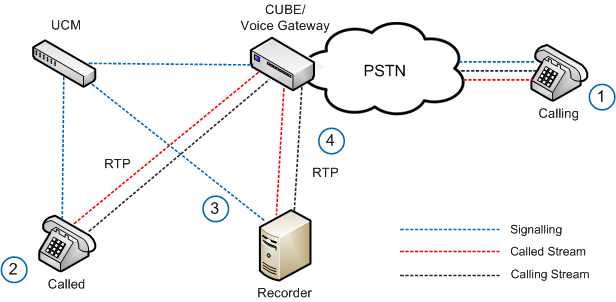
If the gateway stream is encrypted, forking will always be done from the phone.
Here, the UCM sends SIP calls to the
Recording directly with CUBE
The UCM sends SIP signaling to the CUBE, but the CUBE then sends both SIP and media to the Recorder, as illustrated in the following diagram.
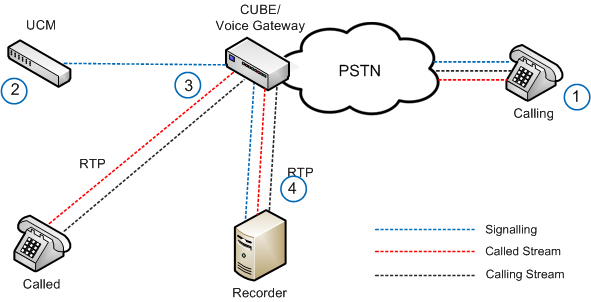
This configuration can only be supported in limited situations. Any implementations should be evaluated by Verint for suitability prior to any solution design or implementation.
The CUBE sends a SIP INVITE to the Recorder via a SIP trunk. When the Recorder respond
Recording remote agents with CUBE
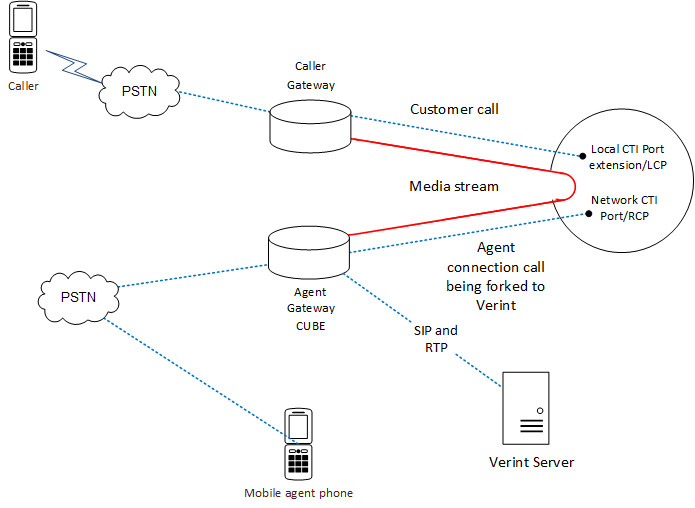
You may record UCCE Finesse mobile/remote agents using the Cisco CUBE Network Based Recording (NBR), also commonly referred to as the Dial Peer Forking recording method (note that this is different from the CUCM Network Based Recording feature). Using this method, the CUBE dial peers are configured to send a stereo fork of the agent’s Remote CTI Port (RCP) SIP call to Verint for recording (the call leg used to establish a connection to the agent's remote device). The Verint system will match up this recording stream with the Local CTI Port (LCP) through the JTAPI CTI feed.
UCCE mobile agents are comprised of the RCP and LCP, bound together within the CUCM. The RCP is used to create the call leg between the CUCM and the agent’s off-switch device. The LCP is used for the discrete calls made and received by the agent. Cisco imposes a strict naming convention for the port names:
-
The local port must begin with “LCP”.
-
The remote port must begin with “RCP”.
-
The remaining characters in the device names for the pair must match.
Using these constraints, the Verint system is able to learn the respective DNs for the LCP and RCP via the JTAPI link, and match the recording to the CTI in real time.