Windows and SQL Cluster solution
Windows and SQL Cluster is an active/passive pairing of Microsoft Windows and SQL clustering technologies. Such a solution requires storing databases on a shared disk.
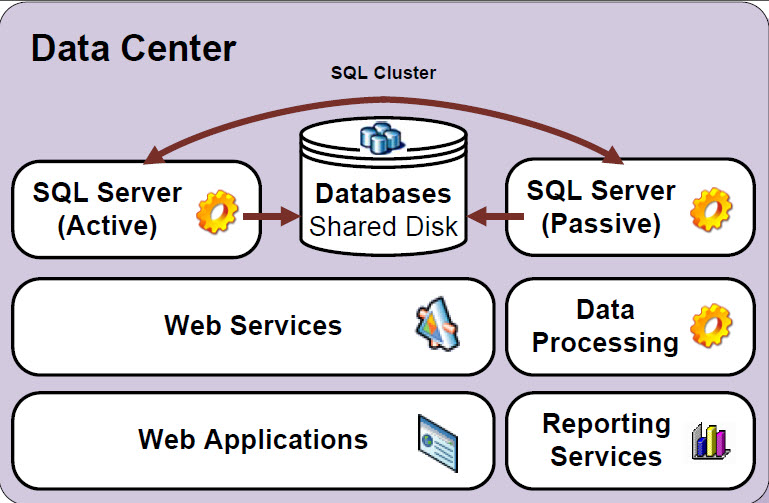
The system supports the deployment of its SQL databases on external servers. In this deployment, the SQL Server resides outside of the servers, and the database platform is configured to work remotely with SQL Server instances.
Customers can optionally use the Windows Clustering solution to support SQL database high availability. The clustering solution includes at least two servers (clustering nodes)—one active server with a running SQL Server instance, and one passive server (known as a standby server) with no running SQL Server instance.
Both servers have the same virtual address. If the active server is not available, the system automatically activates the standby server. This process is known as failover.
Since databases are stored on a shared disk visible to the two clustering nodes, the standby server only needs to run the SQL Services. Applications can continue using the same network address after failover to connect to the databases.
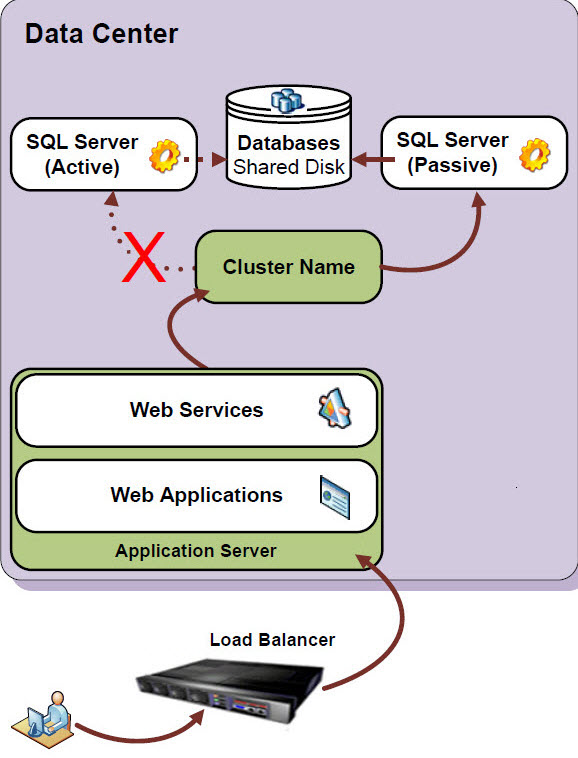
The Database High Availability failover scenario is implemented in the following way:
-
The system creates a session to the active SQL Server through a Cluster Name device.
-
The active SQL Server fails.
-
The system prompts the Application Server to initiate a new connection with the Cluster Name device.
-
When the Application Server reconnects, the Cluster Name device directs the session to the formerly passive SQL Server, which has now become the active SQL Server.