Planned Time Assessment
This report does a daily aggregation of scheduled activity properties per organization, for each workday specified in the time frame input and for all organizations that have employees in the specified employee filter.
This report is similar to the Daily Planned Time Assessment by Employee report but is per organization instead of per employee.
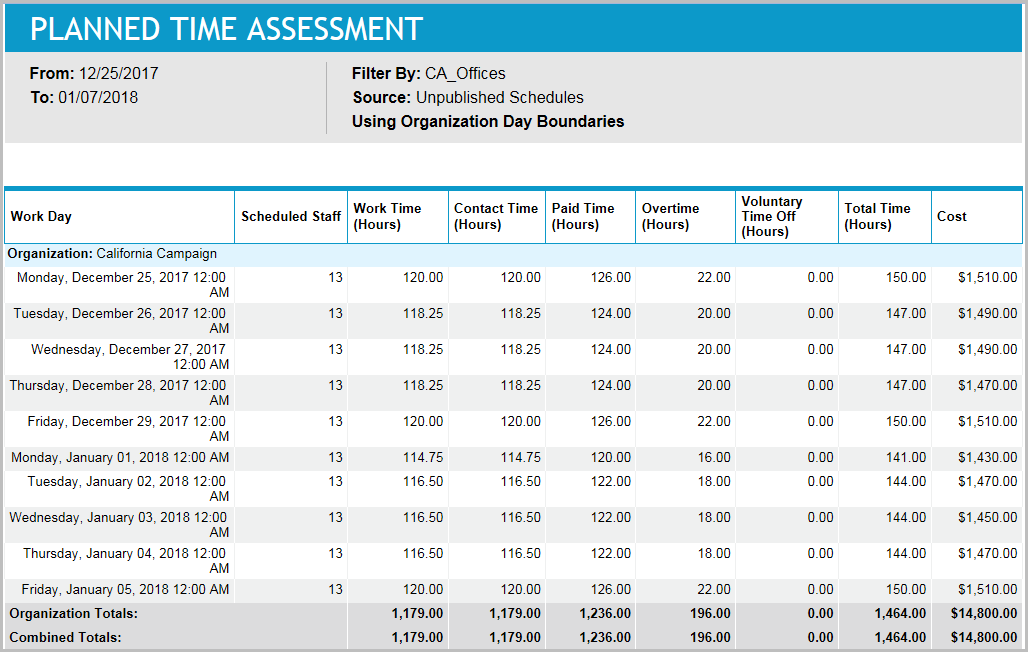
Schedulers can view this report to see quickly for the group how many employees are scheduled each day, and how much work (on media) versus non-work and paid versus unpaid time is scheduled and the total cost of the schedules. It may be particularly useful to review how much work time versus non-work time is scheduled to understand planned utilization for the group.
Default Access Rights
This report can be run by the following roles: Scheduler.
Inputs
-
Employee Filter: Lists the organization on which to report.
-
Schedule Period (reports that are by day and in organization time zone):
-
Last <X> days: This field specifies which days to report on. This mode should return the last X completed workdays for an organization, however, as implemented, it sets the From-date to the current day in the time zone of the SQL Server computer minus X days and the To-date to the current day in the time zone of the SQL Server computer. Depending on the difference between the SQL Server computer's time zone and the organization's time zone and day/week boundary, this may not be the last X completed workdays.
-
From/To date (reports that are in organization time zone): These reports are generally by day or by week. Here, by day/week means the organization's workday or workweek, considering day and week boundaries. So, let’s say you want to report on the workdays 1/10/04 through 1/15/04. The workday named 1/10/04 is actually 1/10/04 8:00 a.m. through 1/11/04 8:00 a.m. (in the organization's time zone). It will map differently in GMT. Now let’s also assume that you are reporting on multiple organizations, each with different time zones and day/week boundaries. You are requesting data on 1/10/04 through 1/15/04, but this could map to different absolute times for each organization. For example:
Org A: 1/10/04 3:00 a.m. - 1/11/04 3:00 a.m., 1/11/04 3:00 a.m. - 1/12/04 3:00 a.m....
Org B: 1/10/04 8:00 a.m. - 1/11/04 8:00 a.m., 1/11/04 8:00 a.m. - 1/12/04 8:00 a.m....
-
Use Published Schedules: Indicates whether to use published or unpublished schedules.
-
Outputs
-
Organization: The organization being aggregated.
-
Work Day: The workday being aggregated.
-
Scheduled Staff: The number of agents scheduled to work on that day.
-
Work Time (Hours): The total work time for workday.
-
Contact Time (Hours): Time is considered contact time if the scheduled activity is linked to a media.
-
Paid Time (Hours): Total Paid time for workday.
-
Total Time (Hours)
-
Cost: The value of Paid Time multiplied by the employee's hourly wage.
-
Overtime: The number of overtime hours, excluding overtime gaps.
-
Voluntary Time Off: The number of voluntary time off hours.
-
Organization Total: The totals for that organization of the Work Time, Contact Time, Paid Time, and Total Time.
-
Combined Total: The totals for all organizations being reported on of the Work Time, Contact Time, Paid Time, and Total Time.