Components on the Recorder platform
The Real-Time Analytics (RTA) Framework is part of the Recorder and operates on the Recorder platform.
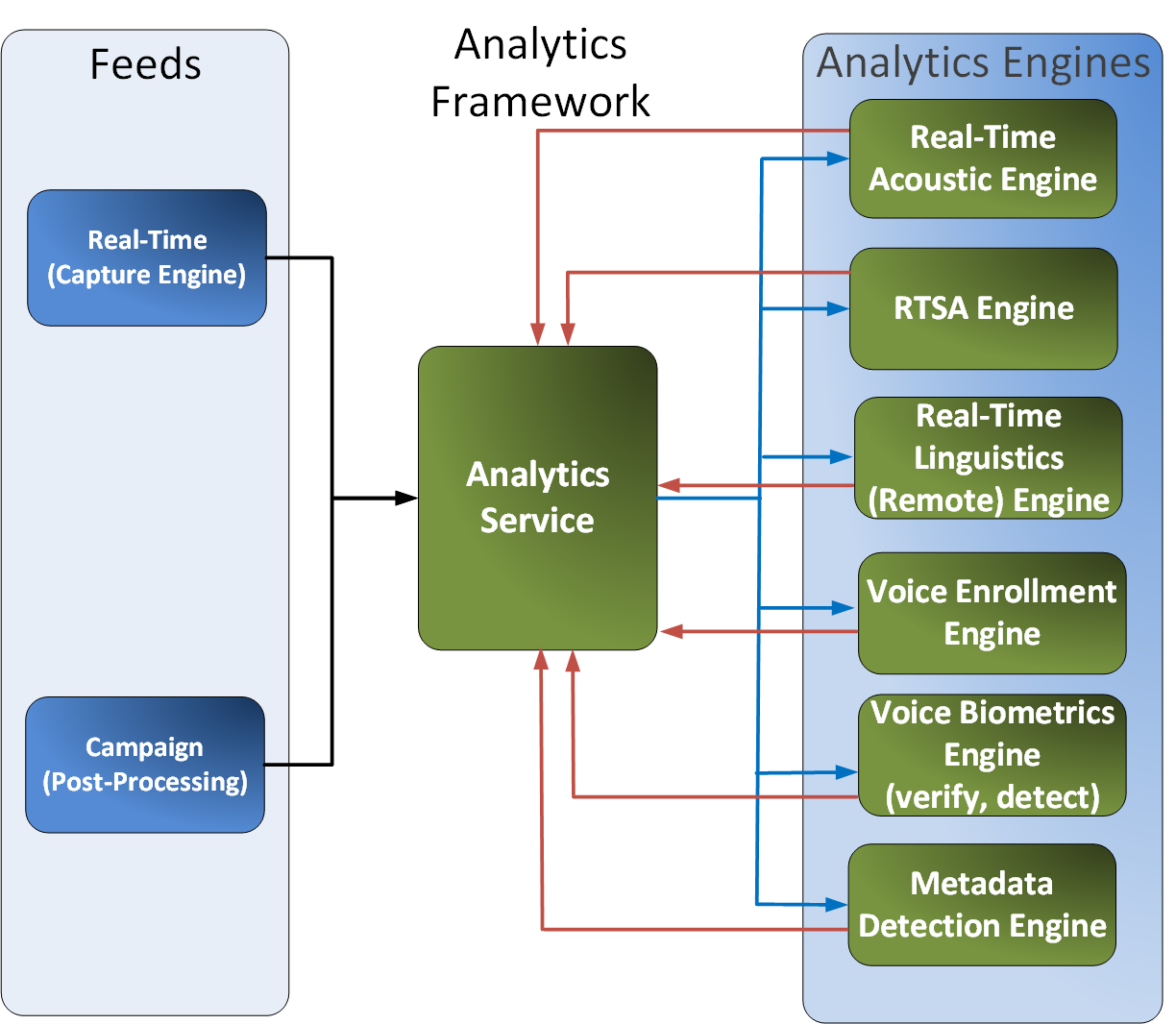
Refer to the diagram shown for a visual representation of the voice biometrics solution components.
Feeds
The Analytics Service obtains audio from the feeds for the analyses.
-
For real-time feeds, audio from the Recorder capture engine streams to the appropriate Analytics Engine. The engine resides on the same recording platform where the Analytics Service runs, with the exception of the Real-time Linguistics (remote) engine which resides on the cloud.
-
For campaign feeds (historical processing), the Analytics Service retrieves audio from the Recorder storage system, either the call buffer or Archive media. Retrieval of audio is a batch process (not real time).
Analytics Service
The Analytics Service is the control center for the Real-Time Analytics (RTA) Framework.
-
For real-time processing, you configure Recorder Analytics Rules to trigger based on events from the Recorder. The Analytics Service delivers audio and other data to the appropriate engine.
-
For campaign-based processing, you configure Recorder Analytics Rules to process interactions that are part of a campaign. Campaign-based rules can:
-
Perform enrollment for employees or customers.
-
Perform verification analysis for employees or customers.
-
Find interactions that match voiceprint models on a watch list.
-
Detect the presence of particular metadata attribute values
-
After the engines finish analysis, the results are returned to the Analytics Service. Based on the Recorder Analytics Rules configuration, the Analytics Service takes actions, such as updates to the database and desktop notifications.
Analytics Engines
-
Real-Time Acoustic Engine (RTAE)
The Real-Time Acoustic Engine detects interruptions and silences that exceed the predefined threshold. Only real-time (capture engine) audio is provided to the Real-Time Acoustic Engine. This engine does not handle campaign-based audio.
-
Real-Time Speech Analytics (RTSA) Engine
The Real-Time Speech Analytics Engine detects when specific words or phrases are spoken in the audio provided to the engine. Only real-time (capture engine) audio is provided to the Real-Time Speech Analytics Engine. This engine does not handle campaign-based audio.
-
Real-time Linguistics (remote) Engine
The Real-time Linguistics (remote) performs the same functions as the Real-Time Speech Analytics Engine, except with this engine, the analytics processing is performed in the cloud rather than on the server on which the interaction is recorded. Only real-time (capture engine) audio is provided to the Real-time Linguistics (remote) Engine. This engine does not handle campaign-based audio.
-
Voice Enrollment Engine
Enrollment is a function of Identity Authentication and Fraud Detection and refers to the process in which audio is provided to the engine to create a voiceprint model. The model is stored in the database, along with unique identifiers for the person. Examples unique identifiers are account number, name, and Employee ID.
-
Enrollment uses the Voice Enrollment Engine.
-
Voice biometrics can perform several enrollments simultaneously.
-
Enrollment can be completed using a single interaction; however, use of multiple interactions for the voiceprint model improves the accuracy of verification.
-
-
Voice Biometrics Engine
The Voice Biometrics Engine is used for verification and detection processes.
-
Verification
Verification refers to the process in which a voiceprint model is compared to audio to determine who is on the interaction. Verification applies to customers and to employees.
-
Target detection
Target detection refers to the process in which the voice of a person on an interaction is compared against a collection of voiceprint models, known as a watch list.
-
-
Recorder Metadata Engine
The Recorder Metadata Engine detects the presence of particular metadata attribute values in the metadata of a captured interaction (Metadata Detection).